Lighthouses are stubborn subjects. Almost everything about them is vertical — the tower, the gallery railing, the glazing bars, the lantern — and they tend to stand in exactly the place where the wind has an opinion about your paper. A kit that behaves beautifully in a warm room can come apart on a headland in ten minutes: pages fold themselves, pencils roll off a rock, a salt film dulls a wash, and the light you came for lasts four minutes.
What follows is a working kit rather than a collector's cabinet. Fifteen items, each one earning its place by solving a problem that actually happens outdoors.
Paper First: Two Books, Two Jobs
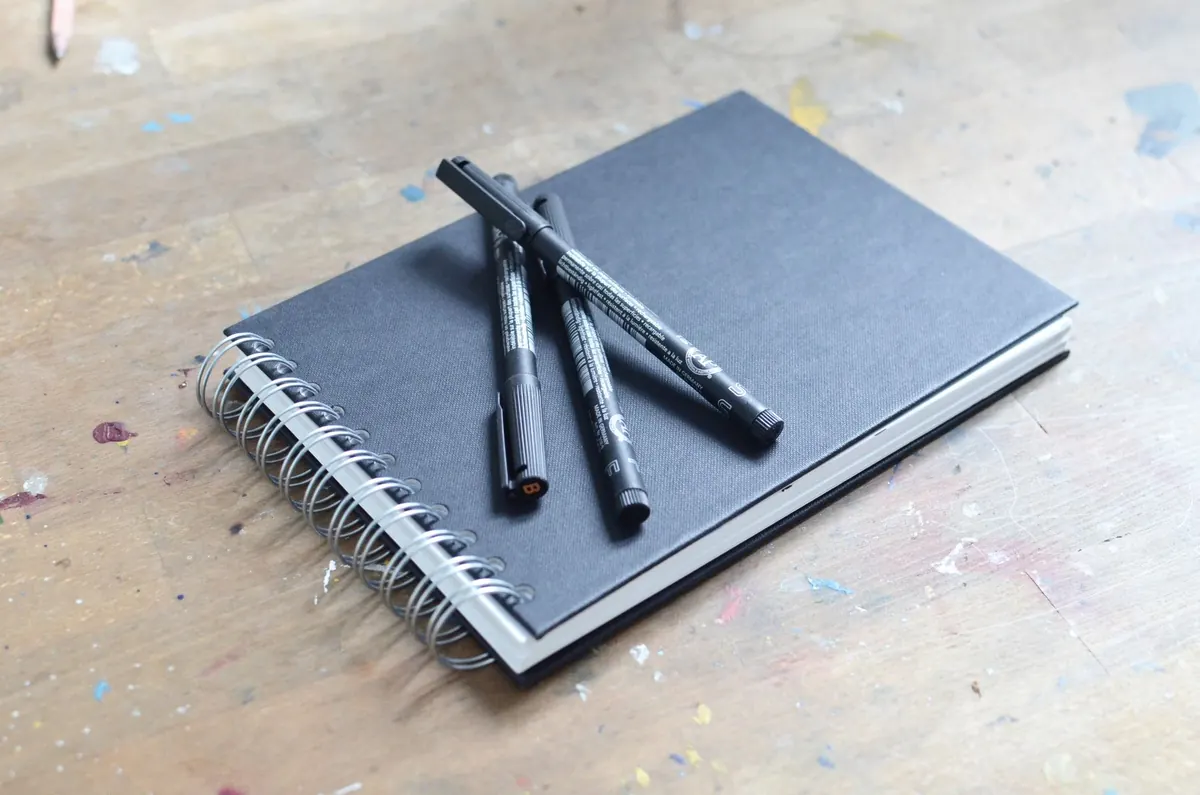
Start with a hardbound sketchbook, roughly A5 and landscape in format, on paper between 140 and 200 gsm. Landscape because a lighthouse drawing almost always begins with a horizon, and a wide page gives the tower somewhere to stand. Hardbound because a stiff cover lets you draw standing up with the book braced against your forearm, and because the wind cannot peel a sewn book open the way it strips a spiral pad.
Weight matters more than most people expect. At around 140 gsm the paper takes a light wash with only a gentle cockle; heavier stock is more pleasant but adds bulk to a bag you may carry for an hour. One book, not three.
The second book is an A6 pocket notebook for thumbnails, two-value studies, and notes: time of day, tide state, wind direction, where the sun sat relative to the tower. Months later those notes will tell you more than the photograph on your phone.
Dry Tools: Pencils and Pens You Can Trust
Three graphite pencils cover nearly everything: HB to block in the tower, 2B for most of the drawing, 4B for the shadow side and the dark band beneath the gallery. Keep a second HB if you can — it is the grade you will dull first.
Then two waterproof fineliners, 0.3 and 0.5. The 0.5 draws the silhouette and the hard edge of the rock; the 0.3 handles glazing bars, the railing, the small window openings that give a tower its scale. Test any new pen on the actual paper before you trust it outdoors: draw a line, wait a minute, wash over it. Plenty of inks marketed as waterproof are only water-resistant, and a grey ghost of your careful railing is a miserable thing to watch bloom across a sky.
A fountain pen loaded with document ink, or a brush pen, adds line variation that suits stonework. One caution: very soft graphite repels ink and leaves a greasy halo. Keep your underdrawing light, or sketch in a blue pencil instead.
Colour That Fits in a Pocket
A pan set of eight to twelve colours is enough. Ultramarine, cerulean, raw sienna, burnt sienna, yellow ochre, a warm red, a cool green and a Payne's grey will carry you through sea, rock, sky and the shaded side of a white tower. Remember that the white of a lighthouse is usually the white of the paper; the paint is for everything around it.
Carry a water brush for speed and a small synthetic round, size six, for edges you cannot fake — the meeting of sea and sky, a crisp roofline on the keeper's cottage. Keep the water brush for sky washes and the real brush for anything that needs a point. On humid days a wash can look dry while it is still tacky, so tilt the book deliberately and let gravity do the work rather than adding more water.
Fixings, Erasers and Small Repairs
The unglamorous items are the ones that save a drawing. A kneaded eraser lifts construction lines without scuffing the surface, and lightly dabbing it over graphite dust before a wash stops your colour turning grey. A metal two-hole sharpener lives in a pocket without cracking; a sandpaper paddle is a good substitute if you prefer a long point.
Four binder clips do more than any gadget on this list. They hold pages flat in wind, clip the book to a board, and let you work one-handed while the other hand steadies you on a slope. Add a roll of low-tack tape, pressed once against your sleeve to reduce stickiness before it touches paper. A thin board of foam or MDF, A4 or slightly larger, turns a rock into a desk. And a microfibre cloth deals with spray on the page and condensation on your hands.
Weather-Ready Accessories
A brimmed hat with a chin cord is not a style choice on a headland; it is what keeps glare off white paper and keeps your eyes on the tower instead of the sun. Pack a rain shell that folds into its own pocket even when the forecast is fair, and a dry bag or heavy zip pouch for the sketchbook itself. Sea air alone will make an unprotected book feel limp by mid-afternoon.
Other things worth the weight: a bottle of fresh water for rinsing salt off your hands before they touch paper, a foam sitting pad, and a pair of fingerless gloves if you sketch in shoulder seasons. Apply sun cream before you start rather than mid-drawing — graphite and lotion make a smear that never quite comes off.
Set up with some awareness of the place. Wind carries spray further than it looks, rocks below the spray line stay wet, and weed-covered stone is slippery even in good shoes. Work with your back to the wind where you can, keep your bag upwind as a small barrier, and let someone know roughly where you are going.
Packing Order and the Fifteen-Item Checklist
Split the kit into two pouches: dry tools in one, everything that can get wet — water brush, cloth, paints — in the other. The sketchbook goes in last and comes out first. Here is the full list.
- Hardbound sketchbook, A5 landscape, 140–200 gsm paper
- A6 pocket notebook for thumbnails and notes
- Graphite pencils: HB, 2B, 4B
- Waterproof fineliners: 0.3 mm and 0.5 mm
- Fountain pen with document ink, or a brush pen
- Pocket watercolour set, 8–12 pans
- Water brush
- Kneaded eraser
- Metal two-hole sharpener
- Binder clips
- Roll of low-tack tape
- Lightweight drawing board or clipboard
- Microfibre cloth
- Brimmed hat with a chin cord
- Packable rain shell and a dry bag for the sketchbook
The Habit That Saves the Page
Before you commit a single confident line, spend two minutes on a thumbnail in the pocket book. Hold your pencil at arm's length and check the tower against it — lighthouses lean in drawings
Photo: Skylar Kang / Pexels